
LVDS is widely chosen because differential signaling is good at rejecting noise, yet that reputation can hide an important practical detail: an LVDS link is only as balanced as the physical channel carrying it. Between the transmitter and receiver are PCB breakouts, fine-pitch connectors, stripped termination zones, cable pairs, shields, grounds, bends, clamps, and nearby power circuits. A small asymmetry in any of these areas can turn a clean differential link into a source of common-mode current, electromagnetic radiation, or reduced signal margin. That is why a cable can pass continuity testing and still fail an EMC test, or work on a bench and become unstable after installation inside the final product.
LVDS cable common-mode noise is usually caused or amplified by imbalance in the differential path, including pair skew, unequal impedance, connector discontinuities, asymmetric coupling, poor shield or ground transitions, and mechanical changes to cable geometry. The most reliable way to reduce it is to preserve pair symmetry, control differential impedance, provide an intentional return path, minimize mode conversion, and validate the complete link with signal-integrity and EMC measurements appropriate to the application.
A useful way to think about the problem is to imagine two nearly identical runners carrying the same message in opposite directions. As long as they stay together, outside disturbances affect them almost equally and the receiver can ignore much of the interference. The trouble starts when one runner takes a longer path, passes through a different doorway, or gets pushed closer to a noisy machine. In real LVDS systems, those small physical differences are skew, discontinuity, grounding, and routing. The sections below show how to find those differences before they become a production problem.
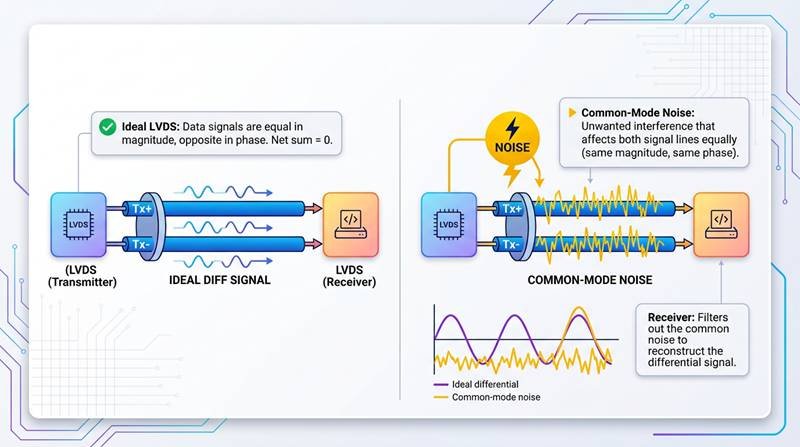
What Is Common-Mode Noise in an LVDS Cable?
Common-mode noise in an LVDS cable is the unwanted voltage or current that appears in the same direction on both conductors of a differential pair. A balanced LVDS receiver rejects much of this shared disturbance, but problems arise when the common-mode level exceeds device limits, common-mode current radiates as EMI, or cable and connector imbalance converts part of the shared noise into differential noise that the receiver cannot reject.